
McLaren Minerals Titanium Project
McLaren is an advanced-stage development project that has progressed through a completed Pre-Feasibility Study (January 2026). The Project hosts a JORC (2012) compliant Indicated and Inferred Mineral Resource estimate of 529Mt @ 4.5% Heavy Mineral (HM) for 23.7Mt in-situ HM, as updated in November 2025.
The Mineral Resource estimate is reported above a cut-off grade of 2% Heavy Mineral (HM) and less than 38% Slimes. The model has been classified as Indicated and Inferred in accordance with the JORC Code (2012). The updated Mineral Resource incorporates reinterpretation of geological domains and additional drilling, significantly increasing the scale and confidence of the deposit.
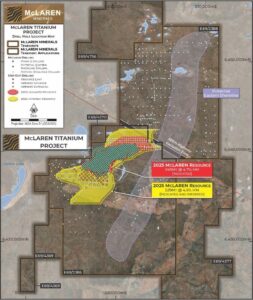
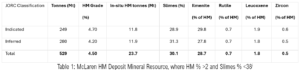
The Mineral Resource update follows the compilation of all available aircore (AC) drillhole data, with additional AC drilling completed since the 2015 Mineral Resource estimate.
The Mineral Resource estimate is based upon aircore (AC) drillholes drilled between 2009 and 2025. Drill samples were assayed for HM (%), slimes (%), and associated mineral assemblage data, which were interpolated into a three-dimensional Mineral Resource block model. Selected drillholes were composited for mineralogical analyses, including QEMSCAN studies, enabling interpolation of key mineral species including ilmenite, rutile, leucoxene and zircon into the model.
The Mineral Resource is classified as a combination of Indicated and Inferred and has been reported in accordance with the JORC Code, with geological and sampling evidence sufficient to assume geological and grade continuity within the volumes classified as Indicated. The classification levels are based upon an assessment of geological understanding of the deposit, geological and grade continuity, drillhole spacing, quality control results, search and interpolation parameters, quality and quantity of mineral assemblage data, and an analysis of available density information.
The mineralisation is hosted within Miocene–Eocene shoreline sands and associated paleo-channel systems. The bulk of the mineralisation occurs within elevated ridges aligned across earlier incised river channels, with strong geological continuity demonstrated over an approximate 5km east–west and 8.5km north–south extent. The deposit comprises relatively free-flowing quartz-rich sands that generally become more clay-rich with depth. Heavy mineral and fines content are variable, with slimes typically ranging between 15% and 30%, and localised pods exhibiting lower fines content.
Key minerals include Ilmenite (dominant), Rutile, Leucoxene and Zircon. These minerals are primarily contained within the sand fraction between 38 µm and 1 mm (“mids”), which represents the economically recoverable portion of the deposit. Heavy mineral content within the slimes fraction (<38 µm) and oversize fraction (>1 mm) is minor to negligible and is not considered economically significant.
The January 2026 Pre-Feasibility Study confirmed a high-level conceptual mining case of 185.7Mt @ 5.85% HM, supporting an initial 15.9-year mine life. Under conservative pricing assumptions, the Study delivered a pre-tax NPV8 of A$252 million, IRR of 26%, and payback period of 3.7 years. More than 60% of the total Mineral Resource remains outside the current mining inventory, providing significant development flexibility and expansion potential as the Project advances toward Bankable Feasibility Study.